- Glossary
- Production planning
Production planning
Production planning in SAP is the process of aligning demand, materials, capacity and production schedules so manufacturers can decide what to produce, when to produce it and at what scale. It uses planning signals such as forecasts, sales orders and inventory levels to drive material requirements planning (MRP) and production scheduling across the enterprise.
In modern SAP environments, production planning rarely lives in a single system. It spans SAP S/4HANA, SAP Integrated Business Planning (IBP), legacy ECC systems and, often, third-party manufacturing or logistics platforms. The goal is to keep supply, capacity and execution synchronized while minimizing downtime, shortages and last-minute replanning.
As a core SAP module, Production Planning (PP) is deeply integrated with other SAP components such as Materials Management (MM), Sales and Distribution (SD) and Plant Maintenance (PM). Together, these modules ensure alignment between production execution, inventory levels and overall operational control.
Production planning as a critical SAP process
In SAP environments, production planning directly affects supply chain performance, manufacturing excellence, financial accuracy and customer service. When planning cycles run late, fail or use inconsistent data, the impact shows up immediately in plant schedules, inventory positions and delivery commitments.
Organizations use production planning to:
- Prevent material shortages and production delays
- Hit inventory and service-level targets
- Coordinate sales, procurement, manufacturing and logistics
- Execute high-volume batch planning cycles inside fixed operational windows
Coordinate production planning across modern SAP landscapes
Production planning in SAP rarely happens in a single system or a single job. It spans S/4HANA, IBP, legacy ECC, integration platforms and downstream execution systems. Keeping these steps aligned requires a Service Orchestration and Automation Platform (SOAP) like RunMyJobs by Redwood.
Enhance SAP Production Planning
Orchestrating the plan-to-produce lifecycle
Production planning in SAP is not a single job or a single system. A typical plan-to-produce cycle spans demand planning, MRP, capacity checks, order creation and downstream execution across S/4HANA, IBP and connected systems. Orchestration is what holds this chain together. Instead of running jobs on fixed schedules, orchestration coordinates each step based on real system state, data readiness and business dependencies.
In practice, this means:
Managing dependencies and timing windows: Ensuring planning runs only start when prerequisite data loads and integrations have completed
Building resilience into planning operations: Automatically handling delays, failures or partial reruns without breaking the entire cycle
Coordinating multi-system planning cycles: Aligning planning, master data refreshes and order creation so each step runs in the right sequence
Maintaining operational visibility: Giving teams clear insight into what’s running, what’s delayed and what’s at risk
What changes when you run production planning with RunMyJobs
Where orchestration defines what needs to happen, RunMyJobs defines how reliably it happens at enterprise scale. RunMyJobs does not replace SAP planning engines like S/4HANA or IBP. It becomes the control layer that governs how and when those systems work together across the full production planning cycle.
RunMyJobs extends automation beyond traditional SAP background job management with:
- Orchestration at scale: Coordinating thousands of interdependent jobs across both SAP and non-SAP systems to ensure a seamless plan-to-produce flow
- Uninterrupted data movement: Automating critical data transfers between planning tools, ERP environments and reporting platforms without manual intervention
- A bridge for the modern SAP landscape: Utilizing built-in, SAP-certified connectors for S/4HANA, ECC, IBP, SAP Integration Suite and Datasphere
- True operational resilience: Supporting long-running production planning processes by managing dependencies and recovery protocols if a step in the chain is delayed
In short, RunMyJobs turns production planning from a timing-sensitive technical workflow into a reliable, observable, business-critical process that can scale with operational complexity.
Make production planning reliable at enterprise scale
Related SAP topics
Explore more SAP platforms and concepts that shape modern integration and orchestration strategies.
Advanced Planning and Optimization (APO)
APO is SAP’s legacy on-premises planning application used for advanced production and supply chain planning prior to SAP Integrated Business Planning.
Integrated Business Planning (IBP)
A cloud-based supply chain solution that supports planning for sales, demand, supply, inventory and replenishment using analytics and simulations.
Supply Chain Management (SCM)
SAP Supply Chain Management (SCM) is a suite of solutions that leverages integrated data and embedded intelligence to align planning, execution and monitoring across sourcing, manufacturing, logistics and distribution.
SAP Cloud ERP (S/4HANA)
SAP Cloud ERP is a cloud-based ERP system that uses AI, machine learning and analytics to automate business processes. It runs on the SAP HANA in-memory database for real-time data processing.
Related reading
Autonomous SAP production planning — Produce more faster and maintain quality
Disconnected systems and manual processes are crippling modern manufacturing, leading to production delays, increased costs and quality issues. Intelligent orchestration with advanced workload automation complementing your SAP solutions offers you a coordinated framework that connects and synchronizes your data, processes and systems.

The automation fabric symphony: Harmonizing SAP data for precision manufacturing
Disconnected manufacturing data can hinder your Industry 4.0 goals. A unified automation fabric powered by SAP orchestration can harmonize your data, analytics and decisions to help you achieve precision manufacturing and a competitive edge.

How automation fabrics protect SAP forecasting and replenishment from failure
Forecasting and replenishment (F&R) looks straightforward to the customer but is a complex production with dozens of systems, processes and dependencies behind the scenes. Explore why even the best demand forecasts fail without orchestration and how an automation fabric can save your supply chain.
Why manufacturing automation has hit a plateau — and what will get it moving
7 in 10 manufacturers are stuck in mid-stage automation maturity. Explore more findings from Redwood Software’s latest research, and discover how to break through this ceiling and resolve common bottlenecks with event-driven orchestration.
Check out these Integrations

SAP Industry Solutions
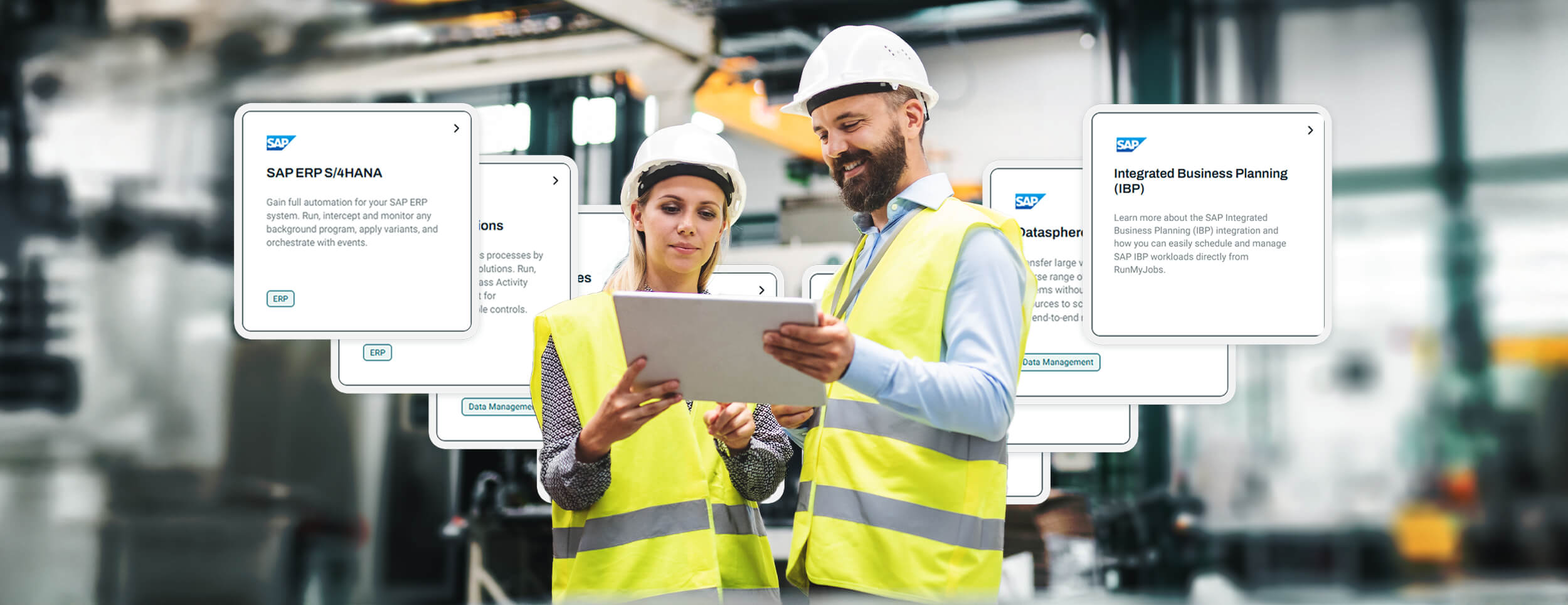
Optimize your core business processes by automating SAP Industry Solutions. Run, intercept and monitor all Mass Activity processes, with full support for parameters for highly-flexible controls.- ERP
-
SAP Integrated Business Planning (IBP)
Learn more about the SAP Integrated Business Planning (IBP) integration and how you can easily schedule and manage SAP IBP workloads directly from RunMyJobs.- ERP
-
SAP ERP / SAP ECC / SAP S/4HANA
Gain full automation for your SAP ERP system. Run, intercept and monitor any background program, apply variants, and orchestrate with events.- ERP

