Engineering observability at the orchestration layer with Redwood Insights Premium
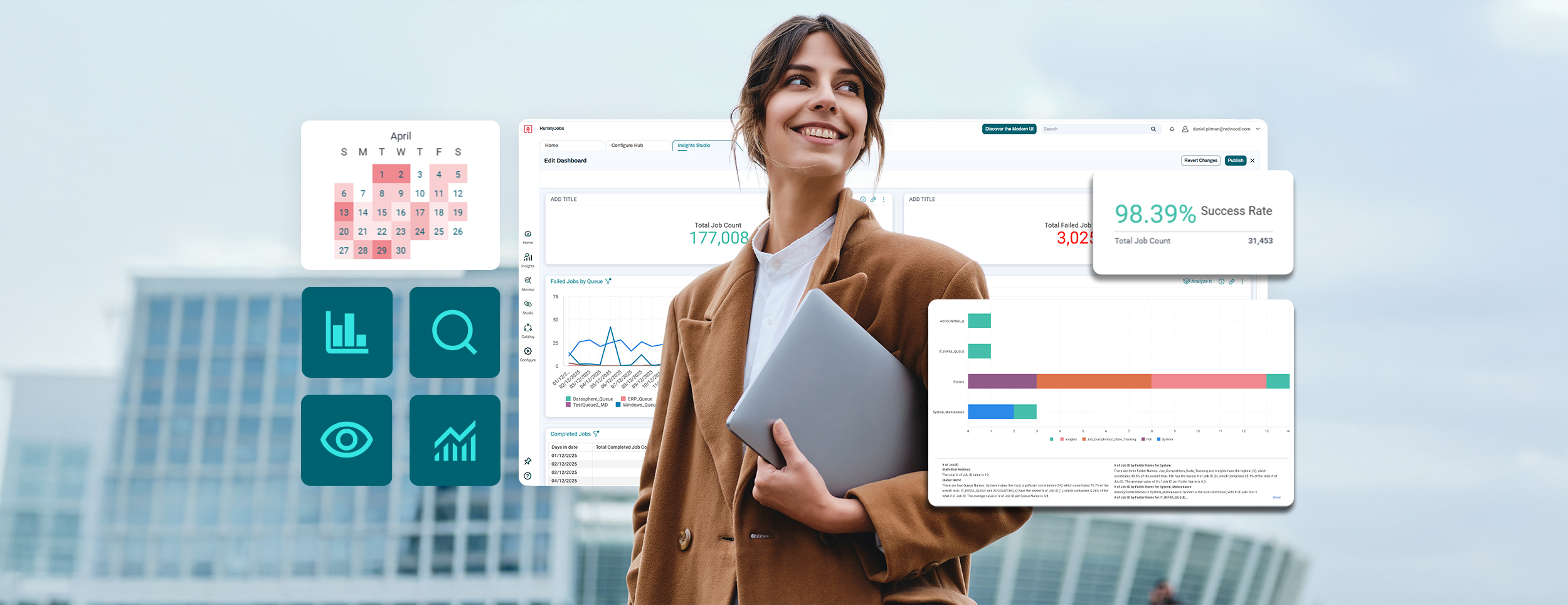
Most enterprises already have monitoring in place for CPU usage, application latency and system health. Dashboards are full. Yet, when a critical business workflow runs late, the same question usually surfaces: What actually caused this?
Infrastructure monitoring tools can confirm degradation, and application performance monitoring can show response times. But neither explains how orchestrated workflows behaved under pressure: how dependencies interacted, where contention formed or why service-level agreement (SLA) risk accumulated.
As orchestration expands across SAP landscapes, cloud-native services, data pipelines and external APIs, that blind spot becomes harder to ignore. Automation platforms generate telemetry continuously, so the challenge isn’t collecting data, but preserving its context.
Without that context, your teams may find themselves working backwards, which often means piecing together timelines, comparing dashboards and explaining outcomes after the fact. With it, they gain something closer to a panoramic view that makes risk visible earlier and turns automation data into a feedback loop they can actually use.
Redwood Software addresses this directly with Redwood Insights for RunMyJobs, embedding observability into the orchestration layer itself — not bolting it on.
Evolving from system signals to orchestration intelligence
Observability platforms were built around applications and infrastructure. They excel at collecting distributed telemetry and tracking system performance.
Enterprise orchestration introduces a different dimension of complexity:
- Cross-platform workflows with layered dependencies
- SLA-bound business processes such as financial close or order-to-cash
- High-volume batch and event-driven workloads
- Deep SAP integration across ERP and SAP Business Technology Platform (BTP)
When an issue emerges, teams often pivot between different monitoring tools, logs and dashboards to reconstruct the sequence of events. The signals are there, but the intent is missing. Correlation must be manual. Thus, mean time to resolution (MTTR) grows because the orchestration logic — how workflows were designed to behave — lives somewhere else (e.g., in RunMyJobs by Redwood).
Redwood Insights closes that gap by keeping execution data tied to workflow relationships, orchestration intent and historical context. Instead of reviewing isolated metrics, you can see how workflows behaved as connected systems.
What changes first is the quality of investigation. Rather than chasing symptoms across tools, engineers start with the workflow itself. Root causes can surface faster and patterns are easier to spot. Less energy has to be expended for reacting and preventing the same issues from repeating.
Native operational visibility in RunMyJobs
Redwood Insights is available to every RunMyJobs SaaS customer, offering:
- Pre-built dashboards that surface execution trends, runtime variance and failure clustering across environments
- Bottleneck visibility that prevents escalation into SLA breaches
- Immutable audit visibility and summarized execution history for administrators — without exporting data to external tools
- A high-level dashboard for engineers to move directly into specific workflow executions, eliminating platform switching or manual correlation
The views above create a shared operational baseline. Your automation health becomes easier to understand, explain and improve upon, no matter if your goal is faster triage, cleaner audits or shorter processing windows.
The impact shows up in measurable ways:
- Root causes take less time to uncover
- Mean time to repair drops
- Recurring bottlenecks surface earlier
- System behavior becomes more predictable across distributed environments
Orchestration gets its own observable voice.
Redwood Insights Premium: Extending visibility to enterprise scale
With automation becoming increasingly central to business operations, observability needs to support more than incident response.
Redwood Insights Premium, introduced in RunMyJobs 2026.1, builds on the native foundation with:
- A no-code dashboard designer for customized views
- Easy sharing of custom dashboards across the business
- 15 months of historical data retention
For many organizations, this marks a shift from short-term visibility to longer-term performance management, moving from “what just happened” to “what keeps happening, and why.”
Custom dashboards and KPI alignment
Different stakeholders require different perspectives. For example, auditors look for records of changes made to automation environments. And Finance leaders care about SLA adherence and process completion risk.
Redwood Insights Premium allows IT to define custom dashboards for tracking KPIs tied directly to orchestrated workflows. Automation performance can then be measured against declared business objectives rather than generic system metrics.
Secure sharing gives process owners and domain leaders self-service access to their own views, while governance remains centralized. This ultimately changes how insights flow through the organization, because IT is no longer the default intermediary. Business teams can have direct visibility into the processes they depend on, too.
Long-term telemetry for planning and governance
Short monitoring windows are useful for resolving today’s incidents, but they don’t help much with planning.
With 15 months of historical data retention, it’s possible to:
- Benchmark year-over-year workload performance
- Identify seasonal execution patterns
- Evaluate the impact of architectural changes
- Support audit and compliance preparation with a continuous execution history
For CIOs and transformation leaders, this longer view supports more grounded ROI conversations. Decisions about scaling orchestration, modernizing SAP landscapes or optimizing cloud consumption can be based on how systems actually behave over time. Observability, therefore, becomes a planning instrument instead of merely a diagnostic tool.
Correlating automation across the broader observability ecosystem
Many enterprises already rely on multiple observability platforms. Infrastructure and application telemetry continue to flow into tools such as Splunk, Dynatrace, New Relic and AppDynamics. RunMyJobs integrates automation telemetry with these platforms, enabling teams to correlate workflow behavior with application and infrastructure performance.
For SAP-centric organizations, the out-of-the-box SAP Cloud ALM connector synchronizes RunMyJobs execution data, including status, start delays and runtime, directly into SAP Job and Automation Monitoring. Automation health becomes visible in the operational interface that SAP teams already use.
Instead of losing orchestration context as data moves between systems, it’s easy to retain a clear picture of how workflow behavior contributes to business risk.
Observability as an architectural decision
Observability is often framed as a DevOps concern. But in distributed enterprises, it’s an architectural one.
As orchestration spans SAP, cloud-native services, hybrid infrastructure and external APIs, leaders need confidence that critical workflows will remain predictable and transparent. Modernization initiatives, from SAP Cloud ERP transformations to multi-cloud adoption, depend on reliable execution.
By embedding observability, RunMyJobs creates a continuous feedback loop:
- Telemetry highlights friction
- Teams optimize workflows
- Reliability improves
- Business outcomes follow
Automation already underpins your most critical processes. With Redwood Insights and Redwood Insights Premium, it becomes fully observable — not only at the system level, but at the orchestration level where business risk actually resides.
Already a Redwood Software customer? Review all the features released in 2026.1.
Ready to democratize your data? Request a demo of RunMyJobs, including Redwood Insights Premium, and see how tailored observability changes how your teams work.
About The Author

Bruno Selva
Bruno is a seasoned product leader with over two decades of experience driving innovation in the enterprise software industry. As Senior Director of Product Management at Redwood Software, he is responsible for driving the evolution of products that help organizations automate processes, enhance efficiency and optimize their data-driven operations.
Prior to joining Redwood, Bruno led the Artificial Intelligence portfolio at Automation Anywhere. His entrepreneurial spirit and technical expertise have been instrumental in his career and have enabled him to launch several innovative products in both established companies and startups. These solutions have significantly improved operational efficiencies for numerous companies that are global industry leaders. Bruno holds a Master’s degree in Software Management from Carnegie Mellon University.

