Capture more ROI from SAP BTP job scheduling with enterprise orchestration
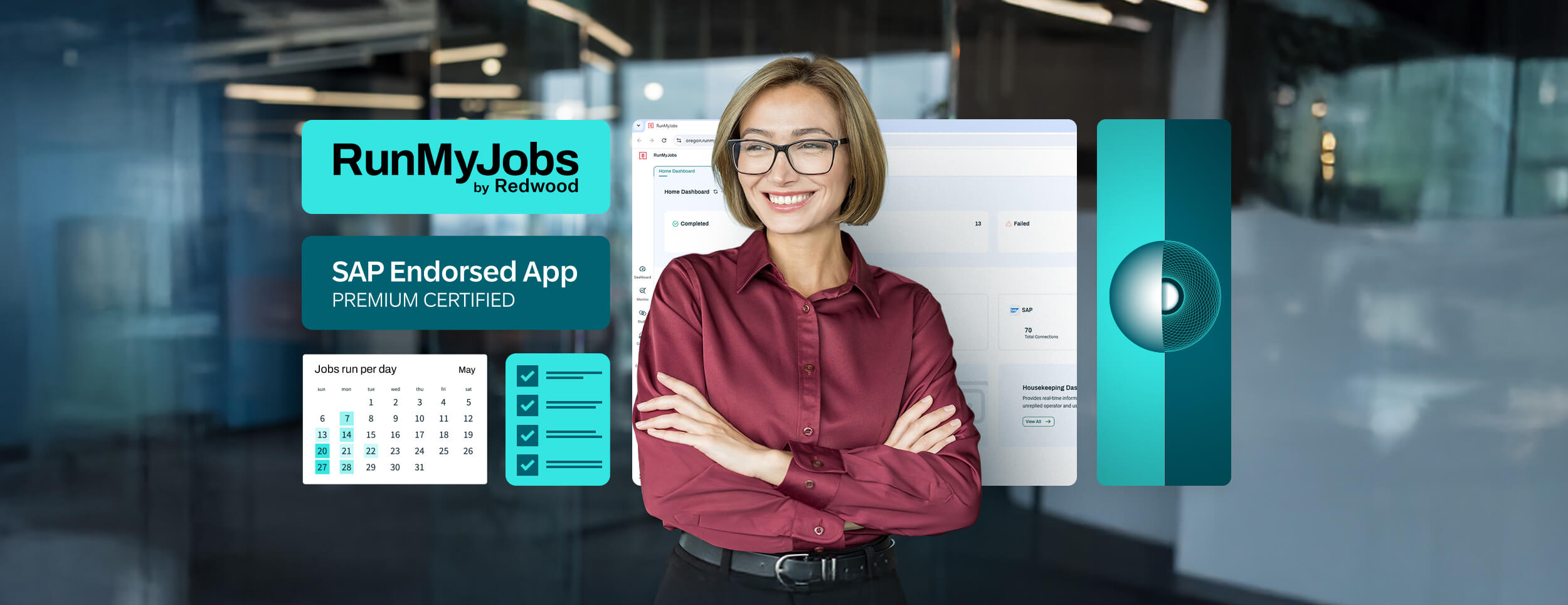
SAP Business Technology Platform (SAP BTP) is where SAP customers turn strategy into execution. It’s the foundation for extending SAP Cloud ERP, integrating SAP systems, handling data management initiatives through the SAP Business Data Cloud (SAP BDC) area of SAP BTP and launching new business applications without disrupting the core.
If you’re using SAP BTP services, you’re likely focused on innovation. You could be building in the Cloud Foundry environment, configuring service instances in the SAP BTP cockpit and enabling SAP BTP job scheduling to support real business processes. You may be creating jobs through REST APIs, defining cron schedules, managing job executions and reviewing run logs to support operational visibility.
Early in an SAP BTP initiative, automation usually stays close to the application it supports. A scheduled job might power a specific service, and a workflow might coordinate a defined business process. In this stage, dependencies feel manageable because they’re tied to a contained use case.
As those applications mature and the scope of workflows increases, the lifecycle expands. What starts as a focused initiative becomes part of broader business processes that span SAP ERP, analytics and integration layers and non-SAP systems. Expectations for real-time triggers, notifications, data transformation and integration and cross-system dependencies grow more complex. As a result, automation and orchestration amount to a shared operational responsibility rather than a local configuration.
Native automation in SAP BTP
SAP BTP includes automation functionality.
The SAP Job Scheduling Service allows you to create jobs, define cron-based schedules and manage job executions within the Cloud Foundry environment. Background jobs can be triggered on demand, based on time or through REST APIs. Execution history and run logs are visible in the SAP BTP cockpit, and service instances can be configured to support different Cloud Foundry applications.
For development teams working only in Cloud Foundry and only requiring basic scheduling capabilities, this model supports operational efficiency while keeping automation close to the application lifecycle.
When scale introduces coordination challenges
As SAP BTP adoption deepens, automation rarely remains confined to one service instance or SAP solution:
- A data management task within SAP Cloud ERP, SAP S/4HANA or legacy SAP ERP Central Component (ECC) may feed analytics dashboards
- An integration flow in SAP Integration Suite could require complex integrations across SAP and non-SAP systems based on custom schedules and and conditional events
- A financial workflow might rely on several background jobs completing in sequence across different runtimes
Hybrid landscapes add further complexity, especially when SAP ECC, SAP Cloud ERP and SAP BTP services operate together. Individually, these systems execute reliably, but they operate largely in isolation, with no native coordination of job dependencies or execution timelines across systems.
When troubleshooting is required, your teams may have to compare run logs across consoles, validate authentication flows, review JSON metadata payloads passed through REST APIs and manually trace dependencies. Service-level agreement (SLA) commitments could span multiple SAP systems, yet monitoring and optimization remain localized.
As SAP BTP services expand, orchestration across environments becomes more complex, as technical configuration often requires significant effort and workarounds and operational governance across systems becomes harder to coordinate.
Why forward-looking SAP customers extend automation
Organizations investing in SAP BTP are typically pursuing broader transformation goals:
- Maintaining a clean core in SAP Cloud ERP
- Accelerating innovation through SAP BTP, BDC and Joule capabilities
- Supporting RISE with SAP transformation
- Improving operational efficiency
- Reducing custom code and technical debt
As business processes stretch across SAP systems, automation underpins core operations. Financial close, order-to-cash, plan-to-produce and forecasting and replenishment workflows and industry-specific processes depend on timely job executions and clearly defined dependencies.
That’s the role of enterprise orchestration.
Cross-system scheduling for mission-critical SAP processes
SAP workloads often sit at the heart of revenue, compliance and customer experience.
For example, financial close processes depend on background jobs executing in sequence across SAP Cloud ERP and analytics platforms. Order-to-cash workflows span ERP, integrations and external systems. Data transformations may move through SAP Datasphere, SAP Databricks or SAP Snowflake before feeding dashboards in SAP Analytics Cloud or being sent as part of compliance reports. In each case, timing, dependencies and SLA thresholds matter.
When these processes run across multiple SAP systems and environments, a delay in one job execution can ripple through the entire business workflow. What looks like a technical issue can quickly become a reporting delay, a missed delivery commitment or an operational bottleneck.
At this stage, scheduling is only part of the picture. You also need confidence that interconnected workloads execute in the right sequence, at the right time and with full visibility across your SAP and non-SAP landscape.
That shift from managing individual background jobs to coordinating end-to-end business processes is where architectural considerations come into focus.
Moving from application-level scheduling to enterprise-grade orchestration
In SAP environments, automation capabilities exist across multiple layers. The SAP Job Scheduling Service in SAP BTP can trigger scheduled tasks for applications deployed in the Cloud Foundry environment, typically through API-based execution. SAP Build Process Automation provides workflow and robotic process automation for processes in SAP BTP. Meanwhile, SAP Cloud ERP manages its own application background jobs through its native job scheduling framework. These services enable automation within their respective environments, but they don’t provide a unified mechanism to coordinate dependencies, execution timelines and monitoring across ERP, SAP BTP and external systems.
Each capability is designed for its respective environment. Enterprise orchestration addresses how these individual schedulers operate together across systems.
A Service Orchestration and Automation Platform (SOAP) coordinates high-volume, time-dependent workloads across SAP Cloud ERP, SAP Integration Suite, the various parts of SAP BDC (like SAP Datasphere and SAP Analytics Cloud), Joule and non-SAP systems. It provides a centralized framework for defining dependencies, monitoring SLAs and maintaining visibility across the entire process chain. Consolidated execution monitoring across SAP and non-SAP systems is possible in the platform and might be published into SAP Cloud ALM in addition.
The enterprise layer connects SAP-native automation capabilities so they function as a coordinated whole across the IT landscape.
A purpose-built orchestration layer
RunMyJobs by Redwood provides that enterprise-ready foundation for agentic orchestration as a fully managed SaaS platform. Delivered in the cloud, it eliminates infrastructure overhead while supporting secure authentication and enterprise governance across SAP and non-SAP environments.
As the only SAP Endorsed App that’s Premium Certified for SOAP and part of the RISE with SAP reference architecture, RunMyJobs is purpose-built for SAP landscapes. It integrates to both legacy and modern SAP solutions through out-of-the-box connectors and comes with pre-built templates that support clean core principles. In other words, it eliminates the need to construct custom orchestration frameworks across multiple SAP tools.
This distinction becomes especially important when organizations scale digital innovations built with SAP BTP. Integrations developed in SAP Integration Suite, data pipelines in SAP BDC services like SAP Datasphere, batch loads in SAP Data Services, analytics refresh cycles in SAP Analytics Cloud and AI initiatives powered by SAP Joule all depend on reliable, sequenced execution.
Enterprise orchestration ensures continuous, accurate and timely coordination of those activities. It enables autonomous integration across SAP and non-SAP systems, optimized execution of high-volume background jobs and centralized visibility into dependencies, notifications and SLA thresholds.
In this way, RunMyJobs allows SAP BTP innovations to scale reliably and efficiently across the enterprise.
How native scheduling and enterprise orchestration work together
Here’s how the distinction between SAP BTP’s built-in automation and RunMyJobs looks in practice:
| Capability | SAP-native tools | RunMyJobs |
|---|---|---|
| Job orchestration across SAP and non-SAP systems | Individual native schedulers within each solution | ✔️ Full hybrid orchestration |
| SLA-based job control and monitoring | Standard monitoring within each respective SAP solution and SAP Cloud ALM | ✔️ Predictive SLA management from a single pane of glass, which can also feed SAP Cloud ALM |
| Cross-application scheduling | Managed inside solution boundaries | ✔️ ️ Pre-built connectors for SAP and non-SAP, orchestrated in one platform and comprehensive workflows. |
This layered model allows SAP-native services to do what they’re designed to do, while RunMyJobs provides the foundation to orchestrate highly complex, time-dependent and business-critical processes.
Supporting RISE with SAP and hybrid landscapes
RISE with SAP initiatives raise the stakes for automation. As organizations modernize their SAP systems, introduce SAP Cloud ERP and expand SAP BTP services, the automation landscape also expands. Core processes, integrations and data pipelines must continue running without interruption while the transformation is underway. That requires coordinated workload management across legacy systems, managed single- and multi-tenant cloud environments and newly deployed SAP innovations.
RunMyJobs supports this landscape through secure orchestration that spans public cloud, private cloud and on-premises SAP systems.
Because it’s part of the RISE with SAP reference architecture, it offers a compliant and lower-risk approach to modernizing job scheduling within a RISE environment. And because there are RunMyJobs connection services managed directly by SAP ECS and operate in the managed RISE architecture, customers retain the flexibility and reliability they had on-premises — without violating access restrictions or compromising compliance. RunMyJobs effectively bridges the gap between traditional, on-premises scheduling methods and the controlled, secure operating environment that RISE delivers.
A stronger operational foundation for SAP BTP innovation
SAP BTP provides the innovation layer, where job scheduling services and workflow capabilities support automation for applications and extensions built on the platform. As SAP customers scale digital innovations across integrations, data management, analytics and AI, service orchestration and automation with a Gartner® Magic Quadrant™ for SOAP Leader ensure those investments deliver consistent, reliable outcomes — and ROI.
RunMyJobs extends SAP BTP with an enterprise-ready solution that complements SAP’s native automation capabilities, supports clean core strategy and aligns directly with RISE with SAP. Read more about unlocking the full value of SAP BTP with RunMyJobs.
About The Author

Neil Krefsky
With over 30 years of experience in product marketing, pre-sales, and business consulting, Neil is a seasoned leader in the tech industry, with a unique combination of subject matter expertise in enterprise automation, financial applications, cybersecurity applications, GenAI, SaaS, ERP systems, contact center solutions, customer experience enhancement, analytics, machine learning, and sustainability.