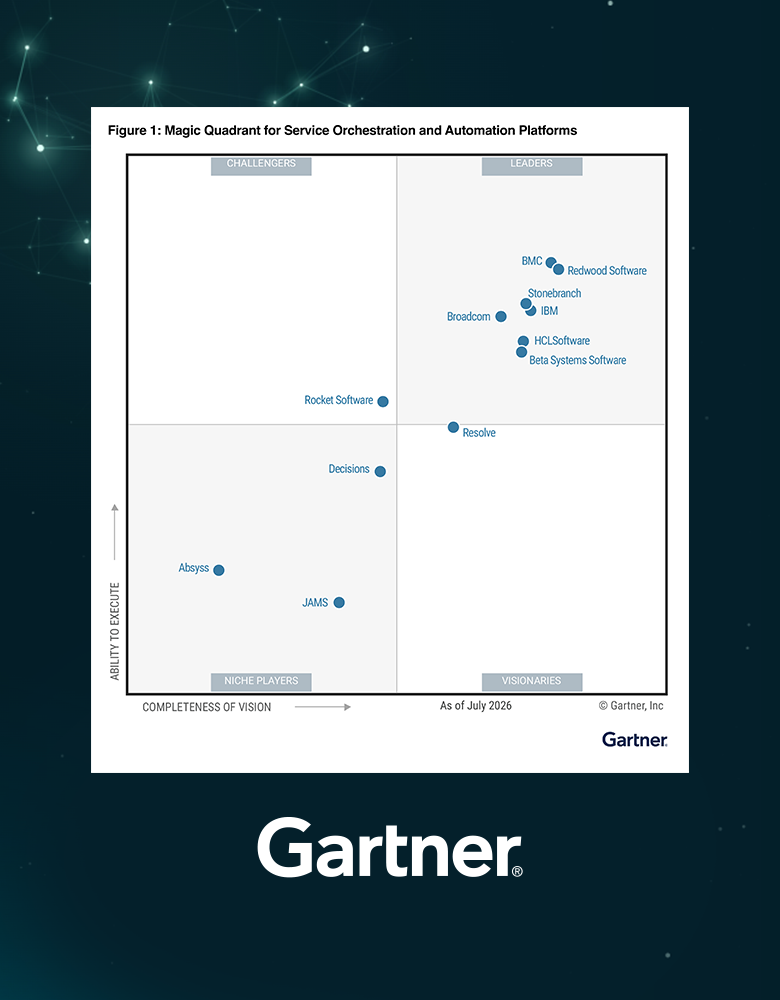
A Gartner Magic Quadrant™ is a culmination of research in a specific market, giving you a wide-angle view of the relative positions of the market’s competitors.
We feel our position as a Leader reinforces our commitment to accelerating the path to the autonomous enterprise. From our roots in job scheduling and workload automation (WLA) to the end-to-end SOAP solution we’ve built today, we believe Redwood helps enterprises optimize event-driven automation and orchestration across hybrid environments to deliver real results.
Furthest in Completeness of Vision
Redwood Software was positioned furthest in Completeness of Vision for the third year in a row. We feel that with 30 years of automation expertise and having delivered SOAP capabilities as SaaS for over 10 years, Redwood’s obsession with customer success and modern orchestration platform continue to drive business outcomes in the agentic era.
We believe that by connecting decades of mission-critical business logic to agentic frameworks, we give organizations the digital infrastructure and functionality to transform AI reasoning into real-world process execution. Key capabilities, including AI-powered observability for proactive issue detection, help teams take informed, confident action, enhance efficiency and manage complex dependencies across the entire automation lifecycle.
Gartner SOAP FAQs
What is a SOAP?
According to Gartner, a Service Orchestration and Automation Platform (SOAP) is described as follows: “Service orchestration and automation platforms are essential for delivering IT services through complex workloads. These platforms unify workload automation, workflow orchestration and data pipelines across on-premises and cloud-native architectures.”
SOAPs adapt to use cases for application architectures, cloud-native infrastructure and data pipelines. Thus, they complement DevOps initiatives and integrate with toolchains to standardize digital business processes.
Infrastructure and operations leaders (I&O leaders) can use SOAPs to design and implement business services with customer-focused agility, improving SLA outcomes and reducing operational costs.
What is the Gartner Magic Quadrant™?
”A Magic Quadrant™ provides a graphical competitive positioning of four types of technology providers in markets where growth is high and provider differentiation is distinct:
- Leaders execute well against their current vision and are well-positioned for tomorrow.
- Visionaries understand where the market is going or have a vision for changing market rules, but do not yet execute well.
- Niche Players focus successfully on a small segment or are unfocused and do not out-innovate or outperform others.
- Challengers execute well today or may dominate a large segment but do not demonstrate an understanding of market direction.”
Gartner, Inc. Magic Quadrant for Service Orchestration and Automation Platforms. Hassan Ennaciri, Daniel Betts, etl. 5 August 2026.
GARTNER is a registered trademark and service mark of Gartner, Inc. and/or its affiliates in the U.S. and internationally, and MAGIC QUADRANT is a registered trademark of Gartner, Inc. and/or its affiliates and are used herein with permission. All rights reserved.
Gartner does not endorse any vendor, product or service depicted in its research publications, and does not advise technology users to select only those vendors with the highest ratings or other designation. Gartner research publications consist of the opinions of Gartner’s research organization and should not be construed as statements of fact. Gartner disclaims all warranties, expressed or implied, with respect to this research, including any warranties of merchantability or fitness for a particular purpose.
These graphics were published by Gartner, Inc. as part of a larger research document and should be evaluated in the context of the entire document. The Gartner document is available upon request from https://staging.marketing.redwood.com/resource/gartner-soaps-mq/.