How unified automation brings resilience to SAP enterprise business intelligence
Enterprise business intelligence (BI) has always promised clarity with dashboards, KPIs and data visualization that help leaders make confident decisions. But clarity on screen doesn’t automatically translate into operational strength.
Enterprise BI isn’t a niche capability. The global business intelligence and analytics market is already valued in the tens of billions of dollars and projected to grow significantly through the decade as organizations invest in real-time insight, advanced analytics and scalable visualization platforms. The “2026 CIO and Technology Executive Survey” from Gartner reinforces that analytics and digital initiatives remain central to technology agendas, even amid economic volatility.
In SAP environments, enterprise BI now spans SAP BusinessObjects on-premises landscapes, SAP Analytics Cloud in the cloud and increasingly complex hybrid architectures, all of which sit within SAP’s broader enterprise data management strategy. Forecasting models draw directly from ERP activity, supply chain dashboards rely on overnight integrations to stay accurate and financial reports must meet strict governance and compliance standards.
The more sophisticated your analytics become, the more critical the underlying orchestration becomes.
The SAP enterprise BI landscape today
SAP’s analytics portfolio has evolved over nearly two decades, from on-premises SAP BusinessObjects environments to cloud-based analytics and integrated data services. In late 2024, SAP introduced the SAP BusinessObjects BI 2025 release with an updated release timeline and maintenance strategy, shifting to a two-year minor release cadence and extending mainstream maintenance for SAP BusinessObjects BI 4.3 through the end of 2026 to support hybrid BI modernization plans.
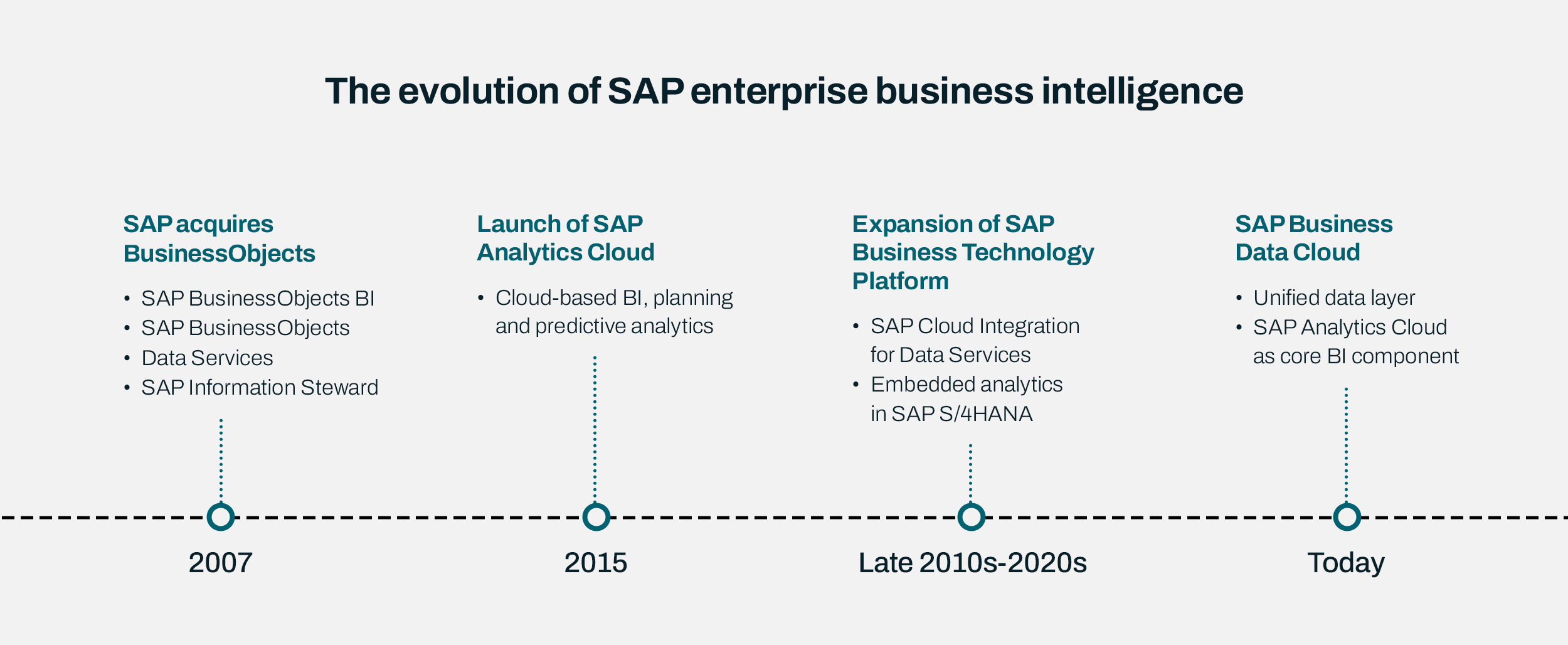
SAP continues to deliver new versions and long-term support for SAP BusinessObjects and related products, and many enterprises plan to run them well into the next decade.
Today, most SAP-centric enterprises operate across several layers of that evolution. SAP BusinessObjects often remains the system of record for regulated reporting, while SAP Data Services feeds SAP BW or SAP Datasphere environments with transformed data. SAP BW process chains handle scheduled aggregations overnight, and SAP Analytics Cloud, now positioned as a core analytics component within SAP Business Data Cloud (BDC), consumes that data for dashboards, planning models and predictive scenarios.
These systems don’t operate independently. A typical analytics chain resembles something like this:
An SAP S/4HANA job posts financial entries → SAP Data Services executes transformation jobs → SAP BW process chains or SAP Datasphere aggregate data → SAP Analytics Cloud refreshes models → Executive dashboards update before 8 AM.
If any step fails, the impact extends beyond IT to finance, operations and executive reporting.
In hybrid environments, especially those moving to RISE with SAP, these workflows often span on-premises systems, SAP Business Technology Platform (BTP) services and cloud analytics. Without centralized orchestration across all of them, organizations rely on disconnected schedulers, manual triggers or custom scripts tied to individual components. That’s how complexity accumulates.
Bringing control to SAP analytics processes
RunMyJobs by Redwood addresses this challenge at the orchestration layer by coordinating how they execute together.
RunMyJobs is the only workload automation solution that is both an SAP Endorsed App and included in the RISE with SAP reference architecture. It connects to SAP systems through supported APIs and secure gateway connectivity and avoids invasive agents or direct ERP modifications. Plus, it provides out-of-the-box connectors for SAP BusinessObjects BI, SAP Data Services (formerly known as SAP BusinessObjects Data Services), SAP Integration Suite – SAP Cloud Integration for Data Services, SAP Analytics Cloud and more, allowing you to orchestrate reporting, transformation and dashboard refresh workflows without custom code.
In practical terms, that means you can:
- Orchestrate SAP BusinessObjects report executions as part of financial close workflows
- Trigger SAP Data Services and SAP Cloud Integration for Data Services jobs based on ERP events instead of fixed-time scheduling
- Coordinate SAP BW process chains and SAP Datasphere with downstream SAP Analytics Cloud model refreshes
- Monitor end-to-end dependencies across ERP, data transformation and BI layers
Instead of scheduling each BI platform independently, you establish a single control plane that understands upstream and downstream dependencies. For example, rather than refreshing a dashboard at 6 AM regardless of data readiness, you can configure SAP Analytics Cloud data actions to trigger only after data transformations and aggregations complete successfully. If a job fails, alerts and remediation steps execute automatically — before business users log in.
Because RunMyJobs is delivered as a SaaS platform with centralized monitoring and AI-assisted troubleshooting, you gain visibility across the entire analytics chain rather than just within a single BI tool.
Strengthening analytics without increasing complexity
Instead of isolated projects, enterprise BI initiatives are typically tied to broader transformation goals like improving operational efficiency, reducing risk and enabling growth. Redwood Software’s framework highlights those same value drivers for SAP customers pursuing modernization and cost control.
Practically speaking, reporting cycles stay on track, data flows cleanly between ERP and analytics platforms and the need for redundant schedulers or scripts falls away. That stability allows analytics initiatives to grow without expanding infrastructure or teams. Most importantly, business users don’t have to question whether the numbers on their dashboards reflect completed, validated workflows. They can focus on insights instead of exceptions.
Reliable insights create real advantage
SAP Analytics Cloud continues to expand its role in predictive analytics, embedded analytics and advanced data visualization. And SAP BusinessObjects remains a stable foundation for many complex or regulated reporting environments. Together, they form a powerful enterprise BI ecosystem, one that delivers its full value when execution across systems is fully orchestrated.
If you’re expanding cloud-based BI solutions, consolidating traditional BI tools or embedding analytics more deeply into ERP-driven workflows, orchestration should be part of the design from the start.
Enterprise business intelligence should enable better decision-making at scale without introducing new bottlenecks behind the scenes. With the right automation foundation in place, your SAP analytics landscape can deliver insights that aren’t just compelling but dependable.
Explore the full set of RunMyJobs SAP connectors to see how unified orchestration supports SAP BusinessObjects, SAP Data Services and SAP Analytics Cloud across your landscape.
About The Author

Sven Kohlhaas
Sven Kohlhaas is Vice President – SAP Product Lead at Redwood Software. He is responsible for the global success and evolution of Redwood’s SAP-related product portfolio, helping organizations orchestrate complex business processes across their SAP and non-SAP systems. His vision is to drive operational excellence by empowering enterprises to maximize the value of their technology investments.
With almost 20 years of experience in the IT industry, most of which at SAP in high-impact product and engineering roles, Sven is a seasoned leader with unique subject-matter expertise. His background spans enterprise software, service orchestration and automation, SaaS and PaaS cloud platforms, GenAI and ERP systems. This deep technical foundation allows him to bridge the gap between legacy environments and next-generation cloud architectures.

