Transitioning to SAP Cloud ALM: The observability question most teams answer too late
On May 29, 2020, SAP introduced SAP Cloud ALM as its cloud-based successor for application lifecycle management, replacing SAP Solution Manager and SAP Focused Run with a SaaS model built for SAP S/4HANA Cloud (now SAP Cloud ERP), SAP Business Technology Platform (BTP) and the RISE with SAP roadmap.
Nearly six years later, that roadmap is well underway. Mainstream maintenance for SAP Solution Manager ends December 31, 2027. Extended support runs through 2030. SAP Cloud ALM is already included in SAP Enterprise Support and most cloud subscriptions, with no additional license required. If you haven’t started your transition planning yet, now is the right time.
Most teams I talk to have accepted the direction. The more interesting question is how to get the most value out of SAP Cloud ALM once you’re there — and how observability fits into that.
What SAP Cloud ALM delivers and how automation extends it
SAP Cloud ALM handles project management, health monitoring and lifecycle visibility across SAP-centric environments. For teams moving away from on-premises systems, it’s a meaningful step forward.
The opportunity grows when your business processes span multiple systems. A typical end-to-end flow might move through SAP Cloud ERP, SAP SuccessFactors, SAP BTP services, external APIs and non-SAP platforms. SAP Cloud ALM provides strong visibility into the SAP application layer. Extending that same transparency to the automated workloads running across your broader landscape is a natural next step that makes your SAP Cloud ALM investment generate an even greater return.
In my experience, the individual step that fails is almost never the step that caused the problem. It might start in a data integration, surface in the ERP and affect downstream reporting by the time anyone notices. Connecting automation execution data to SAP Cloud ALM is what turns that sequence visible, so your operations teams can trace a timeline, not reconstruct one.
Observability from the process layer, not just the system layer
What changes about your observability needs when you move from SAP Solution Manager to SAP Cloud ALM is worth thinking through carefully. SAP Solution Manager was built around on-premises system monitoring, whereas SAP Cloud ALM is built for a world where business processes run across cloud services, SAP BTP extensions and non-SAP systems simultaneously.
The scope of what needs to be visible has grown considerably, and most organizations are already feeling that pressure.
According to EMA’s 2025 observability research, 87% of organizations are running multiple observability tools and actively looking to consolidate, yet fewer than half describe their current visibility as fully successful.
An SAP cloud transition is the right moment to get ahead of that, rather than add to it.
RunMyJobs by Redwood approaches observability from the automation layer. Instead of checking whether individual systems are healthy, it lets you track whether the business process completed as expected — start to finish, across every system involved. And when a process is at risk of missing an SLA before it actually does, AI-driven predictive monitoring flags it early so teams can act rather than react.
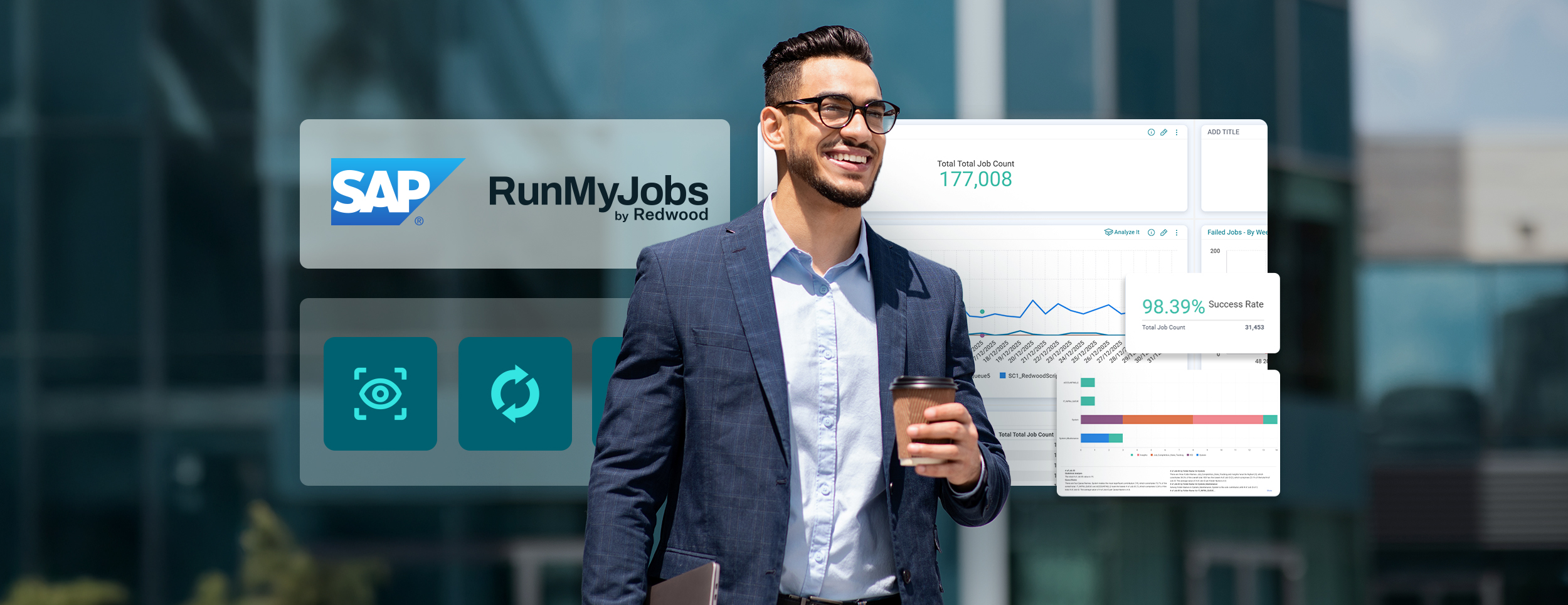
Redwood Insights provides dashboards tied to workflows, SLAs and execution data. Operations teams, business stakeholders and SAP teams can each see what matters to them without waiting for someone to translate technical signals into business terms.
RunMyJobs also connects with platforms like Dynatrace, Splunk, New Relic and AppDynamics, enabling full stack telemetry correlation and accelerating root-cause analysis. When something breaks, you trace the sequence rather than guess at it. Therefore, resolution times drop because the investigation starts in the right place.
Connecting RunMyJobs to SAP Cloud ALM
RunMyJobs has integrated with SAP Solution Manager for years. The new SAP Cloud ALM connector extends that relationship into SAP’s current operational standard to synchronize job definitions, workflow status and execution data directly into SAP Cloud ALM on an ongoing basis. SAP Cloud ALM becomes the command center, while RunMyJobs provides the orchestration and execution layer beneath it.
The powerful combination helps operations teams detect SLA risk before it becomes a business impact, trace root causes faster by correlating automation telemetry with application and infrastructure performance and maintain long-term execution records that hold up for audits and compliance reviews. Self-service dashboards mean business stakeholders can answer their own questions without routing every request through IT.
See exactly how the SAP Cloud ALM and RunMyJobs integration works in practice and watch a demo.
Making the most of your SAP Cloud ALM investment
Moving to SAP Cloud ALM changes day-to-day operations in ways that open up real opportunity:
- You onboard new use cases faster
- Cloud services move from supporting infrastructure to the systems your operations depend on daily
- More systems contribute to each business process
And you’re working with a platform SAP is actively investing in and expanding. The more those systems are interconnected, the more valuable connected observability becomes.
When you can follow a business process across systems from within SAP Cloud ALM, issues stay contained and time-to-market stays predictable. When automation execution data is part of that picture, the operational view becomes more complete — and the value of both SAP Cloud ALM and RunMyJobs compounds.
That’s the case for acting before the 2027 deadline, not just meeting it.
To see how the pieces fit together, explore the SAP Cloud ALM connector for RunMyJobs and Redwood Software’s Platin partner listing in the SAP Cloud ALM Partner Hub. Or, browse the full set of SAP connectors for RunMyJobs to see how automation and observability could connect across your SAP landscape.
About The Author

Sven Kohlhaas
Sven Kohlhaas is Vice President – SAP Product Lead at Redwood Software. He is responsible for the global success and evolution of Redwood’s SAP-related product portfolio, helping organizations orchestrate complex business processes across their SAP and non-SAP systems. His vision is to drive operational excellence by empowering enterprises to maximize the value of their technology investments.
With almost 20 years of experience in the IT industry, most of which at SAP in high-impact product and engineering roles, Sven is a seasoned leader with unique subject-matter expertise. His background spans enterprise software, service orchestration and automation, SaaS and PaaS cloud platforms, GenAI and ERP systems. This deep technical foundation allows him to bridge the gap between legacy environments and next-generation cloud architectures.