SAP Landscape Management reaches end of support: Keeping hybrid SAP operations automated
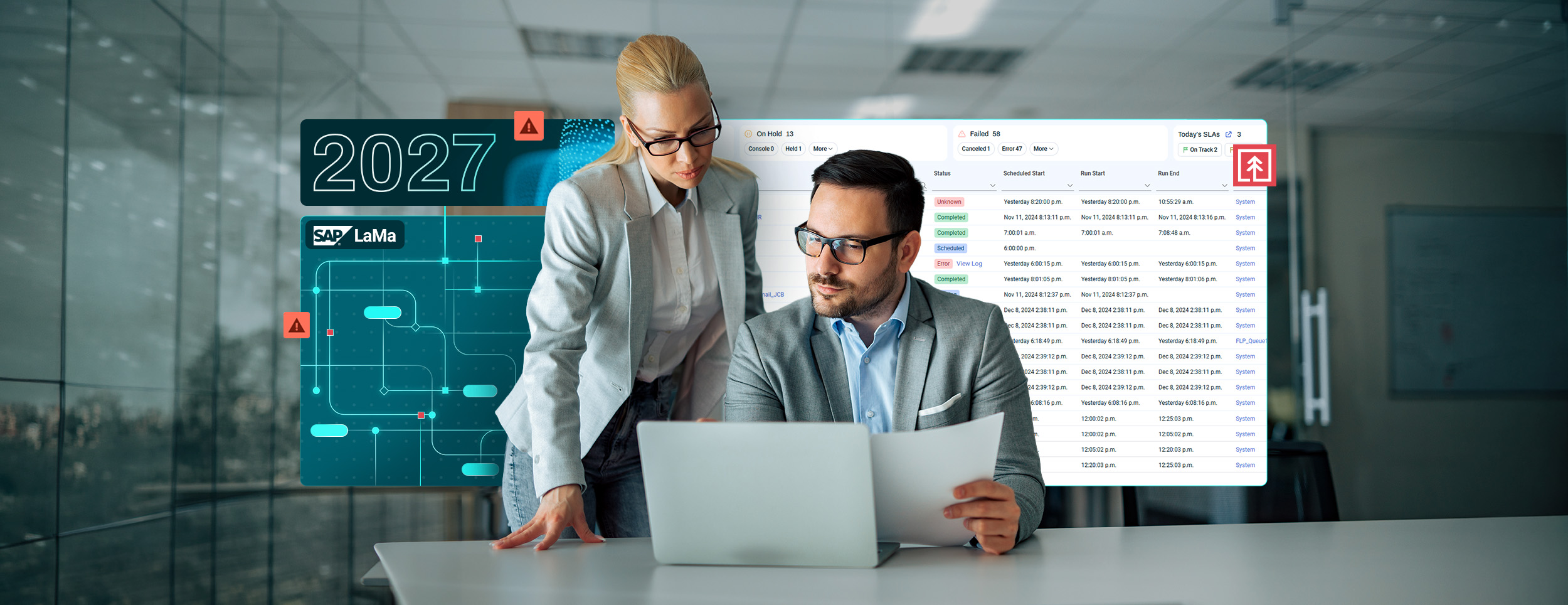
SAP has confirmed that mainstream maintenance for SAP Landscape Management 3.0 will conclude on December 31, 2027, with no extended maintenance currently planned. As an add-on to SAP NetWeaver AS for Java, SAP Landscape Management (LaMa) is directly affected by the end of SAP Business Suite 7 mainstream maintenance. SAP Landscape Management Cloud, which was originally positioned as the cloud-based successor, has since been discontinued as SAP refocuses its strategy on RISE with SAP with SAP Cloud ERP Private and GROW with SAP with SAP Cloud ERP.
That timeline aligns with the end of support for SAP Business Suite 7 (ECC 6.0) and SAP Solution Manager 7.2, making 2027 a convergence point that will reshape how SAP Basis teams approach landscape operations, system monitoring and infrastructure automation.
SAP’s direction makes it clear that the future of SAP operations is cloud-first, standardized and increasingly managed by SAP itself. That strategy is well-founded, and it’s already delivering real value to customers adopting RISE with SAP and GROW with SAP.
For many organizations, though, the transition timeline means hybrid operations will remain a reality for years to come. And SAP LaMa handled a set of operational workflows that don’t retire just because the tool does.
What still needs to be orchestrated
In managed environments like RISE with SAP and GROW with SAP, many traditional SAP Basis tasks are handled by SAP. SAP Cloud ALM replaces parts of the operational capabilities previously associated with SAP Solution Manager, while SAP manages more of the underlying infrastructure.
These don’t eliminate the need for orchestration. Organizations still need to automate system refreshes and copies, SAP Post-Copy Automation (PCA), cross-platform disaster recovery (DR) and cross-system operational workflows that span self-hosted SAP systems, cloud environments and non-SAP applications. These workflows remain essential in hybrid landscapes, even as more infrastructure moves under SAP management.
Customers who relied on SAP LaMa for this coordination need a new approach before support ends in 2027.
The 10-year reality of RISE with SAP transformations
SAP’s investment in managed cloud services gives customers a strong foundation for cloud operations. Virtual machines, high availability configurations and patching are increasingly handled within the RISE with SAP operating model.
But the reality is that most large-scale RISE with SAP transformations are multi-year programs. For numerous enterprises, this is a decade-long journey where, even after completion, certain technical systems will remain outside SAP’s managed perimeter. Manufacturing systems, regional SAP HANA instances, legacy landscapes, reporting environments, industry-specific solutions and non-SAP satellite applications all continue running alongside SAP-managed cloud ERP.
The picture is more grey than black-and-white. SAP’s managed cloud addresses a significant portion of infrastructure operations, and most large enterprise customers with diverse landscapes also need orchestration that extends across what they continue to operate themselves.
Total cost of ownership (TCO) and operational efficiency don’t improve by adding more disconnected tools to cover what SAP LaMa used to handle. They improve through consolidation into a modern orchestration layer that works across every environment in the landscape, managed and self-hosted alike.
Extending SAP operations with RunMyJobs
RunMyJobs by Redwood helps you preserve the automation, orchestration and governance your hybrid SAP landscape still requires. As the only SAP Endorsed App for workload automation and the only orchestration platform included in the RISE with SAP reference architecture, RunMyJobs automates across the full SAP ecosystem while supporting clean core principles through standard, SAP-approved integrations rather than ERP customizations.
RunMyJobs complements SAP’s managed cloud operations by extending orchestration to the systems, workflows and dependencies that customers continue to operate themselves — and covering the operational scenarios where SAP isn’t providing a direct successor.
SAP operations after SAP LaMa
| Capability | SAP-managed (RISE with SAP/SAP Cloud ALM) | RunMyJobs |
| Infrastructure management | ✔ Handled by SAP within RISE with SAP | |
| Application health monitoring | ✔ SAP Cloud ALM | ✔ Integrated via SAP Cloud ALM connector |
| System refreshes and copies | ✔ End-to-end orchestration with parallelized execution | |
| Cross-platform DR failover | ✔ Orchestrated across hybrid environments | |
| Hybrid SAP and non-SAP orchestration | ✔ Single platform across managed and self-hosted environments |
Here’s how that translates to the specific challenges SAP LaMa’s retirement raises.
- Orchestrating across both sides of the managed boundary: RunMyJobs coordinates workflows across self-hosted SAP systems, RISE with SAP, SAP Business Technology Platform (BTP), hyperscalers, databases and non-SAP enterprise applications from a single platform. Operational runbooks, DR procedures and IT service management workflows continue running seamlessly across hybrid environments, instead of fragmenting into disconnected scripts and manual handoffs.
- Keeping system refreshes zero-touch: RunMyJobs orchestrates complete system refreshes end to end, coordinating SAP Post-Copy Automation (PCA) task lists, massively parallelized BDLS processing, database restores, storage operations and validation activities without manual intervention. Instead of reverting to manual scripts, disconnected runbooks and spreadsheets, you maintain standardized, repeatable workflows with centralized visibility and automated error handling.
- Preserving a clean core strategy across the full transformation timeline: As organizations progress through multi-year RISE with SAP journeys, RunMyJobs connects through SAP-approved APIs and integrations free of additional local software and code installation, rather than introducing ERP customizations. SAP Basis teams can automate operational runbooks and cross-system dependencies while keeping custom logic outside the ERP core, making future upgrades and innovation easier to adopt.
- Delivering reliability without adding infrastructure: While SAP manages more of the underlying infrastructure, organizations still need orchestration for hybrid operations. A self-managed replacement for SAP LaMa simply recreates the infrastructure your team is trying to leave behind. RunMyJobs is a cloud-native SaaS platform with 99.95% guaranteed uptime, predictive SLA monitoring and automatic upgrades, allowing SAP Basis teams to focus on modernization instead of maintaining automation infrastructure.
Plan your transition now
The retirement of SAP LaMa, with both the on-premises version and its planned cloud successor now approaching end of support, is more than a product lifecycle event. It signals that the operational architecture around SAP needs to evolve alongside the ERP itself.
More infrastructure will become managed. More ERP services will move to the cloud. More organizations will embrace clean core principles and SAP Cloud ALM as their operational command center.
At the same time, hybrid landscapes will remain a reality for years. System refreshes, DR orchestration, cross-platform dependencies and operational runbooks don’t disappear because the underlying deployment model changes. Coordinating these environments across managed and self-hosted boundaries becomes more important as the architecture distributes.
Treat SAP LaMa’s retirement as an opportunity to modernize your orchestration strategy, and your organization will be better positioned to support both today’s hybrid operations and tomorrow’s cloud-first SAP landscape.
To learn how RunMyJobs automates SAP and non-SAP operations across hybrid environments.
About The Author

Sven Kohlhaas
Sven Kohlhaas is Vice President – SAP Product Lead at Redwood Software. He is responsible for the global success and evolution of Redwood’s SAP-related product portfolio, helping organizations orchestrate complex business processes across their SAP and non-SAP systems. His vision is to drive operational excellence by empowering enterprises to maximize the value of their technology investments.
With almost 20 years of experience in the IT industry, most of which at SAP in high-impact product and engineering roles, Sven is a seasoned leader with unique subject-matter expertise. His background spans enterprise software, service orchestration and automation, SaaS and PaaS cloud platforms, GenAI and ERP systems. This deep technical foundation allows him to bridge the gap between legacy environments and next-generation cloud architectures.