What the Gartner® 2030 prediction means for enterprise automation
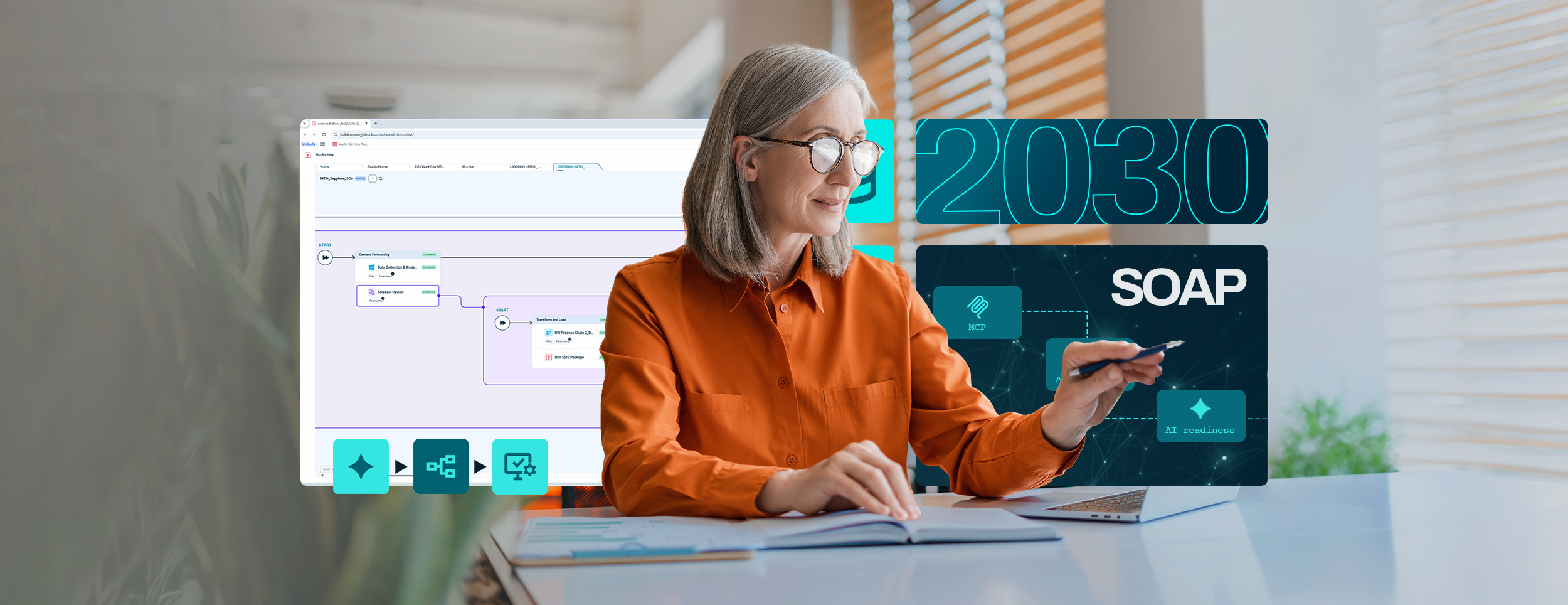
The market is focused on how smart AI agents can become. For mission-critical work, enterprises should be asking a different question: what will the agent use to get the job done?
In the 2026 Gartner® Magic Quadrant™ for Service Orchestration and Automation Platforms (SOAP), Gartner predicts that by 2030, 50% of SOAP activity will be initiated by AI agents, up from less than 5% in 2026.
That forecast says how quickly agent-initiated activity may grow. It doesn’t say how that activity should execute. Our view is that agents won’t figure out critical processes on the fly. They will call vetted, deterministic processes as tools.
Treat 2030 as an adoption forecast instead of a planning date. The architecture decisions that determine whether agent-initiated work is reliable are being made now.
Probabilistic reasoning can’t drive mission-critical execution
Agents are good at deciding what should happen. The same input can produce a different path on a different day. That variability is the cost of inference, and inference is the reason to have agents at all.
A rules engine can’t read a supplier’s email about a substituted part, match it to the right purchase order, judge whether the variance is legitimate and decide who needs to approve it. Free-text email, scanned invoices, an alert that matches no known pattern: none of it arrives in a shape anyone wrote a rule for. An agent can work with all of it.
Take an invoice for 40 pallets against a purchase order for 36. The agent reads the supplier’s note, finds the amended order confirmation in a separate thread and concludes the variance is legitimate. That judgment is the part worth paying for.
What comes next isn’t judgment. The invoice has to post, the accrual has to adjust and the period has to close. Closing the books, moving payroll data and releasing a batch of payments can’t vary from run to run. Those jobs need predictable execution, with defined permissions, dependencies cleared in order and a complete audit trail. They also need bounded retries, an exception path and context that survives as work crosses APIs, data pipelines, cloud services and on-premises systems.
SOAP platforms already do this. Enterprises have run critical workloads on workload automation for decades, and the processes built on it are tested, monitored and understood. An agent that invokes one inherits the proven process. When the workflow improves, every agent that uses it benefits.
Back to the invoice. The agent has done the reasoning and delegates execution to the existing record-to-report process. Dependencies are clear, in order, the right permissions apply, a failure routes to the right team with full context and every action is recorded.
One governed way in
Model Context Protocol (MCP) is standardizing how agents reach tools. Agent2Agent (A2A) is doing the same for how agents coordinate. Fewer connections have to be custom-built, but connectivity doesn’t settle execution rules. The enterprise still decides which dependency must clear, whose permissions apply, how many retries are allowed and where approval sits.
Direct agent access to every underlying system scatters those decisions across the agent layer. A governed process answers them once, and the agent gets one approved way in.
Models, agent platforms and protocols will keep changing. Core business processes can stay put while the technology around them evolves.
Autonomy, process by process
Autonomy won’t jump from “agents recommend actions” to “agents can do anything.” It will expand one process at a time, and the limits should track with the consequences. Some processes can run without review. Others need approval at a specific step or restrict what an agent can change. The same agent can hold different authority in different processes.
Someone has to define the boundaries: what an agent can see, what it can initiate, what happens when execution fails, how every action is recorded. A SOAP enforces them at the process and step level, so AI governance is part of execution rather than a policy document sitting beside it.
Four years is short in an enterprise architecture cycle, and models and agent platforms will turn over inside it. The measure is whether the automation layer absorbs that change without rebuilding proven processes around each new tool.
The full 2026 Gartner® Magic Quadrant™ for SOAP report shows how Gartner evaluates the market and what to look for in a SOAP built for agent-initiated automation.
About The Author

Charles Caldwell
Charles Caldwell is a product and customer success executive with over two decades of experience building and scaling global teams across product management, technical presales, support and services. He has led organizations that deliver mission-critical software, drive customer retention and support complex B2B sales cycles.
At Redwood Software, Charles leads product strategy for its enterprise workload automation and orchestration platform. Prior to Redwood, he was VP of Product Management at Logi Analytics, where he also founded and scaled the company’s Customer Success organization — transforming how support and enablement were delivered.
Charles holds an MBA with a concentration in Entrepreneurship and Decision Sciences from George Washington University and a Bachelor of Science in Maritime Transportation from Massachusetts Maritime Academy.